I’ve spent over a decade building products in startups – starting as an individual contributor, growing into technical leadership, and now leading engineering teams.
Along the way, I’ve seen brilliant engineers burn out, promising products fail despite great technology, and teams collapse under their own success.
The pattern became clear: teams that thrived weren’t just talented. They were balanced across three critical fronts, like military units coordinating offense, defense, and operations.
This isn’t theory. It’s what I’ve observed watching peers navigate their careers, managing my own transitions from IC to team lead, and seeing which startups survive their growth phase and which don’t.
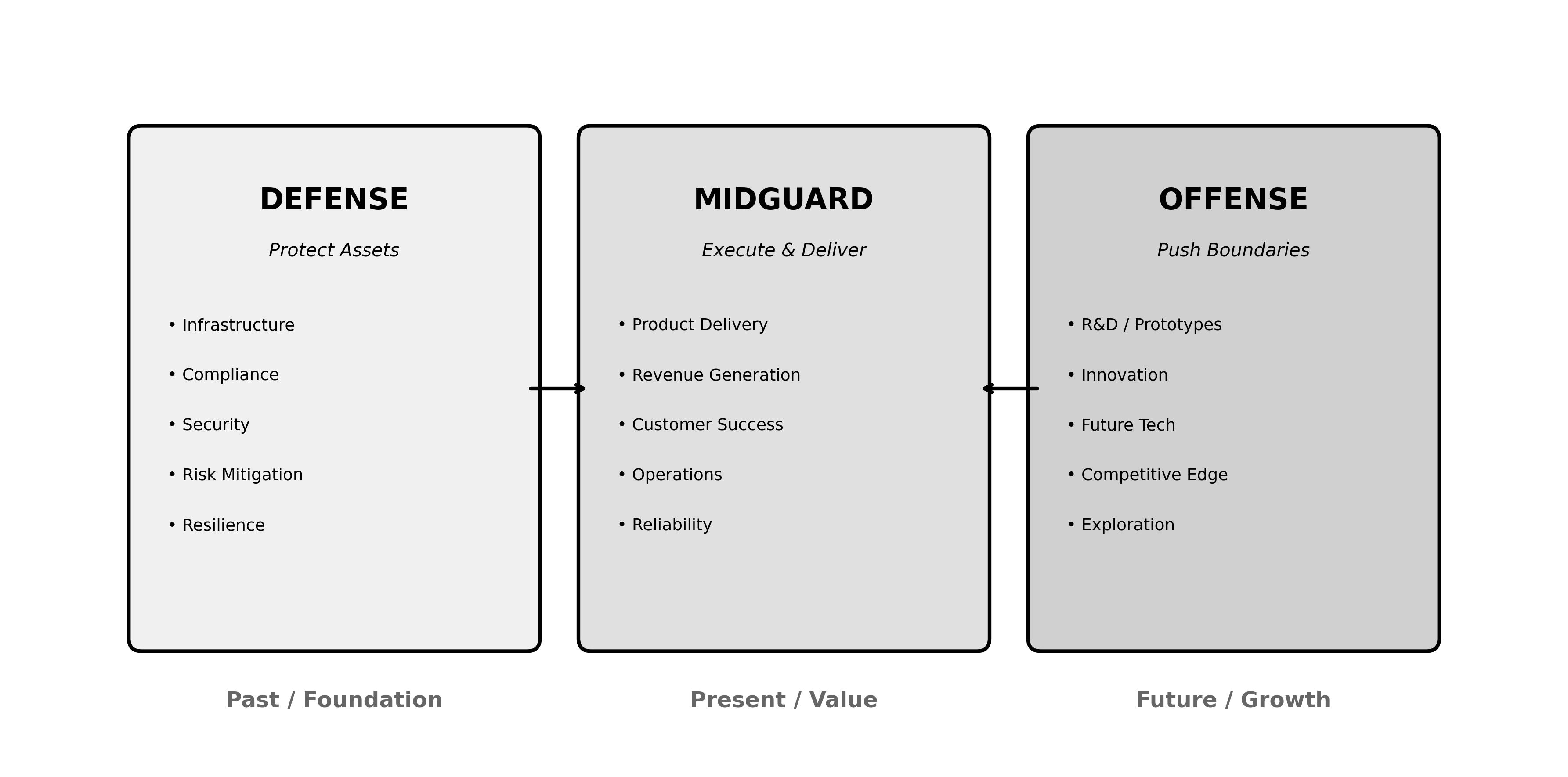
The Three Fronts
In warfare, military strategists organize forces across three domains: the offensive force that pushes boundaries, the defending force that holds territory, and the operational force that maintains daily capabilities. Every high-performing team – whether engineering, product, sales, or operations – needs the same structure.
Front 1: Offense – Push boundaries and create competitive advantage for tomorrow.
Early in my career, I thought everyone should be pushing boundaries all the time. I was that engineer who wanted to rewrite systems with the latest framework, experiment with new architectures, and build proofs-of-concept for features we might need someday.
I was wrong – not about the value of innovation, but about thinking everyone should operate this way.
Offense is about exploration. These team members work horizontally across the organization, unconstrained by immediate commercial pressures. They ask “what if?” and “why not?” Their job is to discover what’s possible before competitors do.
They’re comfortable with uncertainty and failure, future-focused and not bound by current constraints. They think in possibilities rather than probabilities, and work across multiple domains simultaneously.
What they do:
Research emerging technologies and methodologies, build prototypes and proofs-of-concept, test assumptions and validate hypotheses, create intellectual property and competitive differentiation, identify opportunities that will matter 6–18 months from now.
What they don’t do:
Ship to production on a regular cadence, focus on quarterly commitments, or work within established playbooks.
Success looks like: ideas that become competitive advantages, innovations adopted across the organization, patents and publications, technical leadership in the market.
The trap I’ve seen: Startups that are all Offense. Everyone explores, experiments, and pivots constantly. Nothing ships. Funding runs out.
Front 2: Midguard – Execute reliably and generate value today.
When I moved from pure IC work to leading features, I had to shift from “what’s possible” to “what ships.” I learned that Midguard isn’t less important than Offense – it’s what keeps the lights on.
Midguard is about delivery. These team members are responsible for shipping products, closing deals, or executing operations that generate revenue and serve customers right now. They balance speed with quality and ambition with pragmatism.
They’re results-oriented and deadline-driven, customer-focused and business-aware. They balance innovation with reliability and think in sprints and quarters.
What they do:
Ship features, close deals, deliver services, maintain and improve existing systems, meet commitments to customers and stakeholders, optimize for performance and scale, execute on the roadmap.
What they don’t do:
Speculate on far-future possibilities, build things that might never be used, or ignore deadlines in pursuit of perfection.
Success looks like: consistent delivery, revenue growth, customer satisfaction, operational efficiency, and hitting targets.
The trap I’ve seen: Peers who become pure Midguard operators. They ship relentlessly but burn out because there’s no space for exploration or learning. They wake up five years later with the same skill set in a rapidly changing market.
Front 3: Defense – Protect assets and ensure sustainability.
I’ll be honest – early in my career, I undervalued Defense. Security reviews felt like obstacles. Compliance felt like bureaucracy. Infrastructure maintenance felt like unglamorous work.
Then I saw what happens when Defense is neglected – not in catastrophic collapses, but in missed opportunities and cost overruns that hurt just as much.
One example that sticks with me: A startup I knew had been running their product in production for five years. Everything worked. Customers were happy. The product was stable and generating revenue.
Then a major opportunity came – a medtech company wanted to deploy their solution. It was the kind of deal that could transform the business. Except they’d never deployed for a medical company before.
Suddenly, they needed HIPAA compliance. They needed audit logs they’d never built. They needed data encryption they’d implemented inconsistently. They needed infrastructure that could pass regulatory review. They needed documentation they’d never written.
The deployment timeline they’d estimated at three months stretched to fourteen. The cost estimations that assumed straightforward deployment quadrupled as they retrofitted five years of technical debt. The deal still closed, but the margins evaporated, the engineering team burned out from the scramble, and they had to delay their roadmap by two quarters.
All because Defense had never been a priority.
That’s when I understood: Defense isn’t optional. It’s not about preventing disasters – it’s about being ready when opportunity knocks.
Defense is about resilience. These team members think about risks, threats, compliance, and long-term stability. They build the infrastructure that allows Offense and Midguard to operate without being blindsided when requirements change.
They’re risk-aware and detail-oriented, thinking in terms of “what could go wrong” and “what will we need to be ready for.” They focus on sustainability and adaptability over speed, working horizontally across the organization.
What they do:
Build security, compliance, and governance systems, maintain infrastructure and operational foundations, identify and mitigate risks, create disaster recovery and business continuity plans, ensure regulatory and legal compliance, build monitoring and alerting systems, prepare for deployment in regulated environments.
What they don’t do:
Ship customer-facing features regularly, prioritize speed over safety, or ignore edge cases and future requirements.
Success looks like: zero breaches, high uptime, regulatory compliance, disaster recovery capability, being deployment-ready for any customer segment, and accurate cost estimations.
The trap I’ve seen: Treating Defense as “something we’ll add when we need it.” When you need it, it’s already too late. The opportunity is here, and you’re not ready.
Why All Three Fronts Are Non-Negotiable
Over the years, I’ve watched teams optimize for one front and pay the price.
- The all-Offense startup had brilliant engineers, cutting-edge technology, and fascinating prototypes. They raised funding, hired more researchers, built more POCs. They never shipped a product customers would pay for. They ran out of runway.
- The all-Midguard grind meant a team executing flawlessly on a roadmap built two years ago. They hit every deadline, shipped every feature. Competitors launched products with capabilities they couldn’t match. Their market share evaporated while they were busy executing yesterday’s plan.
- The Defense-neglected team shipped fast, innovated constantly, and grew quickly. Then the big opportunity arrived – enterprise customers, regulated industries, international expansion – and they realized they’d built a house of cards. Deployment timelines stretched, cost estimations were wrong, and what should have been their breakthrough moment became a painful, expensive scramble.
My current team balances all three. We have engineers exploring what’s next, engineers shipping what’s now, and engineers ensuring we’re ready for opportunities we haven’t even imagined yet. It’s not perfect, but it’s the only model I’ve seen work sustainably.
The Philosophy in Practice
The biggest leadership mistake I made early on was trying to make everyone do everything. I wanted every engineer to innovate, execute, and own infrastructure.
What I learned: People naturally gravitate toward one front, and that’s not just okay – it’s essential.
Some engineers light up when exploring new technologies. Others are energized by shipping features and seeing customer impact. Still others find deep satisfaction in building robust, secure systems that are ready for anything.
Don’t force the explorer to become an operator. Don’t expect the operator to also be a researcher.
When I restructured my team around natural inclinations, productivity doubled and turnover dropped to zero. People who love what they do perform better and stay longer.
In most startups, there’s an unspoken hierarchy: Offense engineers are “innovators” (prestigious), Midguard engineers are “just shipping” (taken for granted), and Defense engineers are “slowing things down” (cost centers). This is toxic and wrong.
The engineer who built compliance infrastructure enabled a deal that doubled company revenue. The engineer who shipped a feature on time closed a contract that funded six months of runway. The engineer who discovered a breakthrough algorithm created competitive moat. All three are equally valuable.
As a team lead, I now celebrate wins across all fronts equally in team meetings, performance reviews, and public recognition. A deployment-ready architecture gets the same visibility as a launched feature.
Early in my career, I worked in siloed teams where everyone did everything. It was inefficient and frustrating. Now I organize differently: Offense and Defense work horizontally across the entire organization. An Offense engineer explores innovations that could benefit all product lines. A Defense engineer builds infrastructure that protects all systems and ensures deployment readiness regardless of customer requirements. Midguard works vertically within specific products or domains. Midguard engineers own specific features, services, or customer segments and ship relentlessly in those areas. This creates clarity: everyone knows their scope and their responsibility.
I’ve seen teams with the wrong balance pay for it. Startups in their first two years typically need 30% Offense, 50% Midguard, and 20% Defense. You need innovation to differentiate but must ship to survive. You can’t ignore Defense or you’ll be caught unprepared when opportunities arrive.
Growth companies from two to five years typically shift to 20% Offense, 60% Midguard, and 20% Defense. Execution is critical to capture market opportunity. Defense becomes more important as customer segments diversify. Offense can be leaner because you’ve found product-market fit.
Mature companies often need 30% Offense, 40% Midguard, and 30% Defense. They need sustained innovation to avoid disruption, have heavy Defense requirements due to scale and diverse deployments, and Midguard can be more efficient due to established processes.
One rule I’ve learned the hard way: Never let Defense drop below 15%, no matter your stage. The cost of being unprepared for an opportunity far exceeds the cost of proper Defense investment.
When I was an IC, the only path to senior roles was through leadership or becoming a generalist. But I’ve seen brilliant Offense engineers forced into Midguard management roles where they were miserable and ineffective. Now I build parallel career tracks: Principal Offense Engineer, Principal Midguard Engineer, and Principal Defense Engineer. Recognition and compensation are equivalent across fronts. An engineer who loves Defense shouldn’t need to switch to Offense to advance their career.
Operational Mechanics
- Weekly tactical syncs keep things moving. Offense shares experiments ready for productization, Midguard raises blockers preventing delivery, and Defense alerts about emerging requirements or deployment readiness gaps.
- Monthly strategic reviews allow course correction. We assess balance across fronts, reallocate resources if needed, and identify coverage gaps.
- Quarterly planning enables strategic thinking. Offense pitches what to explore next, Midguard commits to what will ship, and Defense allocates infrastructure investments and readiness initiatives.
This cadence evolved from watching communication break down. Weekly keeps things moving. Monthly allows course correction. Quarterly enables strategic thinking.
Clear decision rights prevent endless debates. Offense decides what to explore, which experiments to run, and when to kill research. Midguard decides what ships when, feature prioritization, and engineering allocation. Defense decides non-negotiable security and compliance requirements, when to block releases, and infrastructure standards. Leadership decides resource allocation across fronts, strategic priorities, and rebalancing.
When I didn’t have clear decision rights, we had week-long debates about whether to ship or refine. Now decisions happen in hours.
Early in my leadership journey, I made the mistake of measuring everyone with the same metrics. I evaluated Offense engineers on features shipped (their weakness) and Defense engineers on innovation (not their job).
Now I measure each front differently. Offense gets evaluated on experiments completed, prototypes built and validated, innovations adopted into production, competitive differentiation created, and time from concept to validation. Midguard gets measured on features shipped, revenue generated, customer satisfaction, execution velocity, and commitments met. Defense gets assessed on deployment readiness for new customer segments, system uptime, compliance certifications maintained, accurate deployment cost estimations, infrastructure adaptability to new requirements, and time to deployment-ready status.
The Journey from IC to Team Lead
When I was an IC, I could be purely Offense. I explored, experimented, and pushed boundaries. I didn’t worry much about shipping schedules or infrastructure.
As I grew into leading features and eventually teams, I learned that successful organizations need all three fronts operating simultaneously, and my job as a leader is to balance them.
The hardest lesson: Not everyone should – or wants to – operate like I did. Some of my best engineers have no interest in exploring bleeding-edge technology. They love shipping reliable features. Others have no interest in roadmaps; they want to build infrastructure that’s ready for anything.
My job isn’t to make everyone like me. It’s to understand each person’s natural front and build a team that covers all three.
This philosophy isn’t specific to engineering – it’s universal. I’ve seen it apply to sales teams (Offense prospecting new markets, Midguard closing current deals, Defense ensuring contracts and legal readiness), product teams (Offense researching future needs, Midguard shipping this quarter’s roadmap, Defense ensuring regulatory and deployment readiness), and even operations teams (Offense optimizing processes, Midguard executing daily operations, Defense ensuring business continuity and scalability).
The tactics change. The philosophy doesn’t.
Implementation
After a decade of trial and error, here’s what actually works.
- Map your current reality honestly. Who operates on which front today? Where are the gaps? Most teams discover they’re 70% Midguard, 25% Offense, and 5% Defense.
- Name the imbalance. Don’t hide from it. Tell your team: “We’re over-indexed on execution and under-invested in innovation and infrastructure.”
- Hire for missing fronts strategically. If you have no Defense, hire infrastructure and security specialists. If you have no Offense, hire researchers. If you’re all Offense, hire operators.
- Communicate the framework explicitly. Don’t assume people understand their role. Tell them: “You’re on the Offense front. Your job is to explore, not to ship to production every week.”
- Measure what matters per front. Stop judging Offense engineers by Midguard metrics or Defense engineers by Offense standards.
- Rebalance quarterly. Teams drift out of balance. Check in every quarter and adjust resource allocation.
Conclusion
The three-front philosophy came from watching teams succeed and fail over more than a decade in startups. It’s not about being perfect – it’s about being balanced.
Offense creates tomorrow’s competitive advantage. Midguard captures today’s opportunity. Defense ensures you’re ready when opportunity arrives.
I’ve been the IC who only wanted to build the future. I’ve been the feature lead who had to ship regardless of circumstances. Now I’m the team lead who has to balance all three.
The Hardest Lesson
"Defense isn’t about preventing disasters – it’s about being prepared for success."
The question isn’t whether you need all three fronts. You do. The question is whether you’re building them intentionally or hoping they emerge by accident.
After watching enough teams scramble when opportunity arrives, I choose intention.